Pages

Showing posts with label attitude. Show all posts

Monday, September 17, 2012

Blasphemy

AudioDharma

There are at least three good reasons to listen to Gil Fronsdal's last talk Blasphemy of 2012-09-16 from the highly appreciated Audiodharma-Podcast:

  1. The subject is right now relevant...

  2. ... and yet timeless;

  3. He talks about Kalama Sutta even more detailled than I did in my very first article.

Go hear it! :-)

Technorati Tags: ,

Saturday, April 28, 2012

Fatigue

Müde

On your way to the 10,000 hours ;-) you might encounter an unexpected obstacle: as soon as you have come to the point where you have your end in view and decided to get up a bit earlier an unbelievable fatigue will overcome you!

It’s unfair, I admit :-) but on one hand this is at some point true for everybody and on the other hand it just shows that there is an imbalance of input, process and output.

So, if you are sometimes / often / most of the times (!) tired, go through the following checklist and apply some of the suggestions:

A Input

  • Do you eat enough? If the answer is no or I don’t know, eat more! But be careful: too much food won’t give you more vitality but will make you only obese / slow / heavy ;-) and finally… even more tired.
  • Is your diet balanced and rich in variety? Do you get all you need from the food you eat? Try to minimise / exclude food that is industrially processed and eat instead more fresh and simple food.
  • Too much input will not only cause disturbance on your plate but also on the mental level: that goes from phone calls to tasks that are stressful in the sense of responsibility or emotional involvement. In that case try to delegate these tasks and give yourself regularly or at least once in a while some rest / yoga / meditation.
  • What kind of music do you listen to? If your music is too agitating or even puts you in a state of depression, replace it by something inducing power, optimism and love for life! Don’t tell me now that you don’t like this kind of music ;-) Make a test; check out how you will feel after listening for a while to the new music!
  • Do you practise yoga? If not (or not enough), it is high time you get started (again)! Yoga will give you access to new and regenerating energies!
  • Do you spend sufficient time outdoors? In addition, by spending time in nature you will get new impulses!

B Process

  • Do you sleep well? I don’t ask whether you sleep sufficiently as this can be quite individual but regenerating sleep is essential for everyone. Practise more Shavasana before you go to sleep. And apply Yoga Nidra!
  • Check your prevailing thoughts! Don’t let negative thoughts destroy your day-to-day life.
  • Do you get angry very often? If so, meditate more often… and do even more Shavasana.
  • Boost you inner fire by means of Uddiyana Bandha, Nauli Kriya and Pranayama!
  • What about periodical cleansing? Cleansing in the meaning of physical as well as mental (think of Shatkarma ;-)). Every type of dirt, either physical or mental, is baggage you carry around and which will make you tired. Therefore, apply the Shatkarma-techniques regularly as dirt accumulates all the time, regardless of having or not yet having internalised the necessity of periodical cleansing.

C Output

  • Do you endeavour to do too much (physically, mentally, emotionally)? If that what you do is exhausting either because you have to do it or you want to do it (you masochist ;-), reduce your efforts.
  • Do you make enough physical efforts? Even if this sounds strange: a lack of physical activity leads to tiredness. A well proportioned amount of physical activity keeps you fit – walk/ run/ cycle outdoors, not indoors, so that you will not only move more but also spend more time outside, in nature (see also above)
  • Do you do something you really like? Something you enjoy and that makes you forget the time? Perfect, do it more often ;-)!

Please see also this article- a lot of things have been said before but some others havn't!

Technorati Tags:

Fancy more time?

Unendlich Zeit

In order habe the time to do all the things you want to do & to eventually get to the 10,000 hours, 2 advices:

  • First of all use the already existing time frames even if they are sort of small. That means: do yoga whenever you can! Whenever you sit and it is possible sit in a yoga posture. Breathe consciously when you remember it! Do Trataka whenever the opportunity comes up / in waiting periods. And meditate in the same way! The minutes you gain will sum up to more practice time and - even more important- will help you to become more aware of how to handle your time and your goals. And that's the point!

  • Secondly: get up earlier! Otherwise you miss one of the most beautiful and most silent times of the day! You don't have to start tomorrow getting up at 4 am, a few minutes earlier than usual will do for the time being and they will bring you - again important - a different inner attitude.

Technorati Tags:

10.000 hours - the limit to amateurism

10000 Stunden

Some time ago I read an article in which two Aikido-Masters were being compared. I don’t have it to hand anymore so that I cannot quote names and numbers but that should not harm the message of the article.

The article was to compare the effective training-hours of the two Aikido-Masters. Hence the hours on the mat were summed up.

For the first master, an American ( I think?!), they calculated at minimum 10 hours per week. He had been practising 2-3 days for approximately 5-6 hours.

For the second one, a Japanese (I am absolutely sure about it :-), who literally lived in the Dojo, they came to a total of at least 70 hours per week. He had been exercising 7 days a week for ca. 10 hours. As a matter of fact, compared to the American master, the Japanese master had the lead.

Assuming that they had had the same exit criteria, the first Aikido master would have had to live at least 6 more lives ;-) than the other - on the understanding that the Japanese master would change his life style and start being interested in let’s say Origami or Ikebana instead of Aikido ;-) - to come to the Japanese master’s level of experience.

Aside from sense and non-sense of such comparisons one question is arising which indeed could be asked for yoga practice as well: when is enough enough? When is the magical threshold reached, when will I have gained so much experience that a real profound change of my life will take place? When will I become a real professional instead of a mere contributor to the club’s fee?

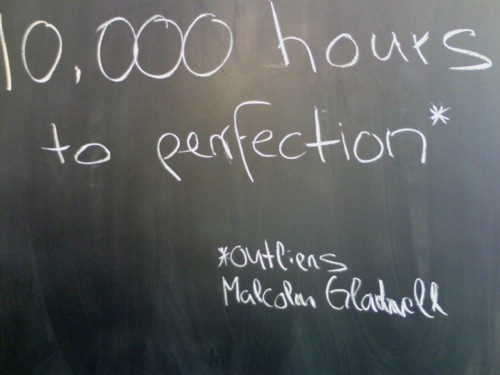
In his book Outliers Malcolm Gladwell is exploring this question. In an elaborately documented research he relativises the frequently quoted argument of Talent / Gift / Calling and demonstrates that it is nearly almost (always?!) a mixture of a well chosen moment, ambition, passion and, finally, work, i.e. effective hours on the mat :-). And this is what Bill Joy (one of the founders of Sun Microsystems), The Beatles and Bill Gates - to name just a few of who have been examined carefully in the Outliers book - have in common.

The right instant of time is probably difficult to control and the same goes for our interests which are (partly!) out of our conscious influence.

But what definitely lies in our hands is the amount of work which we put into what is near and dear to us.

Thus, it is as simple as that: if you are really interested in something, do it as intensively as you can! That alone brings the experience and in the end mastership! Nowadays it is not necessarily wisdom that gives a head start to the masters (even if some masters under the pretense of tradition hinder the transfer of knowledge in order to create and maintain artificially established power structures or just to get - nothing else than financial - privileges!), but it still is the 10.000 hours-effort which not everybody is prepared to sacrifice for something. 10.000 hours in which you practise, sweat and try to make go until you finally have internalised and adopted what you wanted to learn.

Conclusion here: if you want something different from what you experience today, do something different - and do it as intensively as possible and more often than once a week :-) - from what you have done so far! Don’t blame your lack of talent ;-), but recognise your chance and go for it!

Look at Michael Jordan’s Maybe it’s my fault and stop looking for reasons! Just get started!

Technorati Tags:

Awareness

In the light of recent events I would like to remind you of some of the advantages of yoga.

How do you benefit from doing yoga? We’ve had that one before, haven’t we? Health, emotional balance, … But there are things which are to be found rather on the meta-level and one of which is today's subject: to be aware of yourself.

In which way can this be achieved by yoga?
On starting practicing the asanas I have to learn how to feel myself or my body so that, eventually, I will know how long/far/intense I can practise a posture or a technique. If it hurts, surely I can grit my teeth and continue but it’s for no good.

To say it with David Coulters words:

Honor the suggestions of pain

Do you honor or ignore messages from aches and pains? If you have back pain, do you adjust your posture and activities to minimize it, or do you just tough it out? And do you keep a deferential eye on your body, or do you find that you get so wrapped up in some challenge that you forget about it? If you do not listen to messages from your body you will be a candidate for pulled muscles, tendinitis, pinched nerves, and ruptured intervertebral disks. To avoid injury in hatha yoga you have to develop a self-respecting awareness.
Begin your program of hatha yoga with a resolution to avoid pain. Unless you have had years of experience and know exactly what you are doing, pushing yourself into a painful stretch will not only court injury, it will also create a state of fear and anxiety, and your nervous system will store those memories and twart your efforts to recreate the posture. Pains is a gift; it tells us that some problem has developed. Analyze the nature of the problem instead of pushing ahead mindlessly. With self-awareness and the guidance of a competent teacher, you can do other postures that circumvent the difficulty.

David H. Coulter - Anatomy of Hatha Yoga

Pain protects us from accidents so much is obvious - but still sometimes they happen!
When do they happen?
Irrespective of the reasons, they happen whenever I am not 100% attentive, not totally concentrated, not being aware of myself! Whenever the connection to myself is somehow interrupted and my attention isn't set enterily on me.

In time you learn - only a few days/weeks/months (some need years!) and torn muscles (learning the hard way!) later we become more attentive, more sensitive and more concentrated. Pain is a good teacher! :-/

I.E. explicitly, there always has to be a second instance of me, running in the background, which is constantly questioning: How do I feel right now? How does that feel now? And how does that feel compared to a second ago?

In my opinion this is one of the most important things we can learn from yoga (maybe even the thing). Every yoga practitioner should at least learn: how to be aware of one self and how to get a feeling for oneself. Make sure you always have a state to compare from, a state zero - a reference and the ability to improve the current state. All this tells me how I actually feel today and how far I can go today - in my yoga practice and my relation-ship, my work etc.

Finally take a look at this article by Mark Foster - a completely different view but quite interesting!

Technorati Tags:

Monday, November 22, 2010

In the beginning, there was light

Am Anfang war das Licht.jpg

Yesterday I went to the Glückaufhaus cinema in Essen to see the film: In the beginning, there was light.

The film’s subject was living on light. The film shows in an uncomplicated way P.A. Straubinger's (a journalist of the Austrian radio-station Ö3 and the film's director) approach and handling of the subject, meeting several people who don’t follow a normal diet like you and I, but rather who don’t eat at all (!). The film is quite interesting and worth seeing. I just want to tell you about a question which came into my mind when I saw the film.

First, some background information:

  • Prof. Dr. Anton Luger, an Austrian doctor, internationally acknowledged metabolism expert and head of the Klinischen Abteilung für Endokrinologie und Stoffwechsel at Vienna's medical university, is absolutely convinced that abandonment of food for a longer period will lead to death. To fast on liquid too would even accelerate this process.

  • Prahlad Jani, an Indian yogi has been living without food for more than 7 decades (!). He does not even drink water! He admitted himself into a modern hospital, under strictest observation (the declared aim was to expose him as a charlatan). The doctors did all kind of tests on him - from blood analyses to x-ray and computer tomography - eventually they had to accept that he is a mystery for today’s medicine.

Apart from these miracles I was wondering about who is in the right here :-), the Austrian doctor or the Indian yogi?

Both of them are right! They both live what they believe. Paracelsus said in the 15th century: Like man sees himself in his imagination, so he will become. And he is like he has seen himself in his imagination. and also Henry Ford stated similarly: Whether You Believe You Can, Or You Can't, You Are Right

It is not a question of which alternative is the best - in the sense that better gives more degrees of freedom - but in the way in which we create our own reality, this was my point here.

Even the Austrian doctor would without a doubt like to have more degrees of freedom - but he would have had to do something he does not know, cannot do or does not want to do. The knowledge and disposition to carry out or do what we know to be true works like a filter for our own reality and is in this way a limit to our degrees of freedom. Even more than that: It is not only a filter for what we experience but also a determiner for the course of our further life in this reality (see also the films The Butterfly Effect & What the bleep do we know).

The Indian yogi shows explicitly that there is also another reality which is as tangible as our normal world.

How exactly do we determine our reality & life through our believe systems? And how does this work for a yogi?

I learn about something that sounds interesting to me (Yoga is good for you or more precisely Uddiyana Bandha cures numerous deceases or more esoteric ;-) Vipassana Meditation brings inner peace and salvation)… at first it is only an incomplete information, a snippet, rather meaningless and at the same time meaning everything. But there is something which is attracting me, calling me to learn more about it. It’s only an assumption which I have not checked to be true or not, but I still decide that it is worth studying further in this direction.

And then?

I start to read, google and ask about it. I collect information where ever I can. I try to bring life to the elliptic sentences, to build a coherent construct, the whole thing gets more and more substance. Yet, it is still a model without any practical relevance for my life. If I stop here everything remains - once again - only intellectual knowledge. And the only thing I can do is to talk about it in a very superficial way with poor chances to change my reality.

So I have to take one decisive step: I have to do it!

After extensive studies and investigation, after I know how and when it has to be done, after getting competent help (coming back to the above mentioned example: by means of a yoga course or a yoga book or a meditation retreat) I have to start applying it.

Only by taking this essential step I create the setting for the manifestation of the things learned. Otherwise I talk all my life about things other people have reached.

And if I practise (yoga, Uddiyana Bandha Vipassana) something honestly, regularly for a longer period of time my reality will change: I will feel different, act differently and think differently. At first this is of course only subjective, internal, hardly perceptible. And it is not necessarily a rupture but a continuous extension of the former reality (so that the reality of the Austrian doctor is a subset of the Indian yogi’s - no other reality but a part of something bigger). And at latest when this can be seen by others - like in the case of the Indian yogi - it is cleary a sign that my subjective reality has won objectivity :-).

P.S. I have not stopped eating. Nor drinking ;-).Yet.

Technorati Tags: , ,

Monday, November 1, 2010

Each and everyday? Nothing less than that!

Groundhog Day.jpg

In my previous article I stated that daily practice is essential.

Do you really mean "daily"? Every single day? You are kidding, aren’t you? Sometimes you just don’t feel like doing yoga… or you have something better to do!

Yes, I am really serious about it :-) every day – no excuse, no exception!

Is this actually realistic? Is it even possible to do something on a daily basis for a lifetime?

Yes, I think so! Because we do a lot of things every day: eating, drinking, washing (about dental hygiene we’ve talked already :-)… why can yoga not be one of these things?! Why do we never ask ourselves, do I really have to eat today again?! That’s torture – maybe I don’t fancy eating today! but at the same time question our yoga practice again and again? That was subject of my previous article.

Is it possible that only you are so extreme?

I honestly don’t think so.

Swami Shivananda Saraswati said once that he did not even want to miss a single day of his yoga practice due to the profound physical and psychical effects on him.

And H. David Coulter explains in his unique book Anatomy Of Hatha Yoga, why this makes sense even from the anatomical point of view – more on this in my next article.

In addition I know several other absolutely normal people who have been doing yoga on a daily basis for years.

Uncountable factors can be the reason for an imbalance: daily stress, exhaustion, constant information overflow, inattentive and inadequate diet, environmental toxins, not enough exercise and so on. The second thermodynamic principle - entropy increases in every system – is also true for our life… and eventually, sooner or later, when our body gets completely out of balance and we die, entropy will win this match.

Therefore: every attempt to counterbalance this chaos tendency by doing yoga eases the pain, heals wounds and restores - magically! - the order and brings us peace, room and time.

What exactly my daily yoga practice looks like is another question. It depends on long-term goals and is constantly adapted to current and urgent needs – no room for boredom here ;-). The main thing is: daily!

Thus follow the example of the turtle in Achill’s tale: take one step every day, no matter how small or slow, and you will cope with even the greatest challenges in your life. Each little daily step makes sure you realise that you are still alive, that you do something for your life and that you don’t - never ever – give up. This will give you physical and psychic strength: you confirm every day anew that you can, that you want and that you know how to and that you act accordingly. Base your yoga practice on this foundation and you will move forward with assurance: each day anew, each day more intensive.

Take your daily yoga practice like the elixir of Life – every single day!

Technorati Tags: , ,

Sunday, October 24, 2010

Yoga = Dental hygiene?!


IMG_4784.jpg

Each of us has a daily routine. These are not exactely the most interesting things in our life but we see them as absolutely necessary.

A banal exemple: dental hygiene. Who can say that dental hygiene transports one with joy? Trivial? Definitely! But at the same time a necessity - so we just do it and that’s it!

Some of these things seem to become a daily torture ("Mom, do I REALLY have to brush my teeth? Today again?" :-)) but they make sure that we function in an optimal way and help to avoid problems in the long run. And so what we finally learn are long-term strategies for a better life

  • we learn them and at some point we do them automatically, without being aware of it.

Optimal is relative, and also subjective, so there are slight differences in our daily routines. That is why some of us function better than others.

Why this introduction?

In order to formulate an idea: yoga should not only be a daily practice of a special group of people (yogis) but should be seen as normal as dental hygiene. Too often yoga is considered to be only a weekend-activity or postponed for a free time or even seen as wellness programme!

Therefore you should not forget that yoga - like other inner methods - is a method to preserve the physical, mental and lastly spiritual hygiene, even if nowadays it is seen as a rather exotic sport.

Every omission or neglection of yoga practice will lead to immediate harm, which will be noticed only later, when we feel the toothache.

Of course, every analogy has its limits therefore I don't want to generalise. Apart from the obvious differences between yoga and let's say dental hygiene (!) there are some more interesting parallels:

  • Both should be done on a daily basis. Daily yoga practice brings you higher benefits than only one or two sessions per week. Who would think of brushing his teeth only twice a week? With yoga we tend to practise even more seldom… maybe also because our teeth – as part of our outward appearance – seem to be more important to us than our inner health… or just because we have been cleaning our teeth for so long. Please remember: our daily routine has the most powerful impact on our wellbeing.

  • At the beginning both are exhausting, a torture! Like parents who have to answer the question "Do I have to brush my teeth today?" again and again – I, as a yoga teacher, always have to deal with the typical beginner question: How long do I have to practice technique X? Being an adult we do that technique X gladly… especially when we get the results immediately, so that we don’t have to do it anymore after this ;-)

  • Both take time! We spend so much time on so many things which on the long run will not effect us as essentially as yoga will – let’s think about that!

  • Both sound like must-do, drill, discipline, and force! Maybe only at the beginning (and every beginning is difficult!)… I believe it is rather a question of how we see it (see next point)

  • Forgotten or neglected, both will inevitably lead to pain. Deep, pure pain! This is motivation, isn’t it ;-)?

  • Both are easy to carry out! Everybody can brush his teethes and also everybody can practise yoga! Maybe not everything right from the beginning but all the techniques are designed in such a way that really everybody can practise them according to his level and with efficiency.

Therefore: integrate yoga in your daily programme, in your daily routine. Transform yoga into something normal… at least as normal as dental hygiene ;-)

Technorati Tags:

Monday, October 11, 2010

Shape your attitude

Buddha Eyes.jpg

"(...)
Rely not on the teacher/person, but on the teaching.
Rely not on the words of the teaching, but on the spirit of the words. Rely not on theory, but on experience.
Do not believe in anything simply because you have heard it.
Do not believe in traditions because they have been handed down for many generations.
Do not believe anything because it is spoken and rumored by many.
Do not believe in anything because it is written in your religious books.
Do not believe in anything merely on the authority of your teachers and elders.
But after observation and analysis, when you find that anything agrees
with reason and is conducive to the good and the benefit of one and all, then accept it and live up to it.
(...)"

One of the countless translations of the Kalama Sutta of Buddha.

Rely only on your experience from your own practice. It shows you what you have actually achieved. It gives you a direct feedback. It is tangible.

Reflect continuously about your practice. Do not go on autopilot, do not fall into daily routine. Better stay in the freshness, the curiosity, the magic of the first yoga lesson.

Stay alert!

Do not resign!

Do not reject as a matter of principle; be open (minded) but do not accept blindly.

By means of yoga you should open your eyes and strengthen your ability to discern. Do not use the eyes and discernment of others - with all due respect - use your own abilities.

Trust in yourself!

Technorati Tags: ,