Pages

Showing posts with label NLP. Show all posts

Sunday, May 8, 2011

Trataka


Trataka

To keep your end in view at all times can and must be learned by means of Trataka which is the appropiate technique to do this.

Trataka means continuous gazing in Sanskrit and is one of the most important and simplest concentration exercises in yoga. Practising Trataka thus implies constant gazing at an object without closing your eyes or blinking in the meantime.

You need an object - your concentration object!

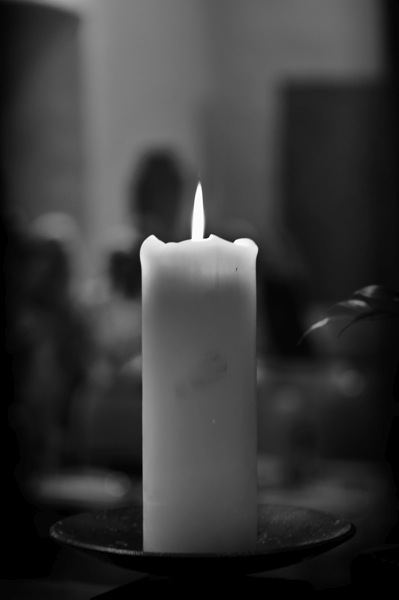
The chosen object should be simple and you should feel a spontaneous attraction towards it. The list for possible concentration objects has no limits - here are only some propositions: a black point, the sun (but please only at sunrise or sunset when the sun is still red and its light intensity on a low level), the sky, your own reflection in the mirror, somebody's eye, the darkness, the moon's reflexion in water, a crystal, a button, the picture of a beloved person, the flame of a candle...

Choose your concentration object with care and then stick to it!

Doing Trataka demands in the first place to fixate your concentration object in a relaxed and steady way. You focus completely on your object of concentration. If you notice your thoughts flying away or you are losing yourself in daydreams, turn back gently to your concentration object. If there is the slightest feeling of discomfort close your eyes immediately and stay like this for a while. Then open your eyes and repeat the exercise.

As soon as this exercise is easy to master, go to the next phase: combine the external concentration with visualisation. For that, close your eyes and concentrate on the negative image which is mostly perceptible the second you close your eyes. Or imagine the image of your concentration object like you have seen it just before. The image might appear only vaguely at the beginning but keep on practising and it will improve. The image will appear and after a while disappear - then you bring it back and it will disappear again. This will go on for a while until no image at all will be perceptible. Then open your eyes anew and start over again.

The intensification of this is to concentrate on a non-existing object. So you begin with your eyes closed and draw in (in your inner eye) the image of our concentration object - without fixating it with your open eyes in between. By practising this technique your are not only training your power of concentration but also your ability to visualise. Implicitly you improve your memory. And as a consequence your draw nearer to our original idea: keep your end in view!

What exactly does it mean to keep the end in view? How does it work?

First of all you have to have found a goal.
What do you wish for? What do you want to achieve? And above all: how do your formulate your goal?

Here the basic knowledge of goal formulation:

1.- Define your aim in a concrete an precise way. Resolve all possible W-questions in this context (e.g. clarify what you need for it and / or set a dead line for the realisation of your target if possible etc.)

2.- Pay attention to the words in the formulation of your aim: avoid all kind of comparisons and use exclusively positive wording!

3.- Do the eco-check: what are the consequences for you and others if you reach your goal?

4.- Is your goal realistic?

5.- Is your aim really desirable? Is this your heart's desire? Are you really behind it or are there inner objections?

6.- Does the realisation of the goal depend only on you?

7.- Can you measure a progress in the achievement of your goal? If possible define your goal in milestones.

Use the seven points above as a check list after you have found your aim.

And now that you have found and formulated your goal visualise yourself immediately after the achievement of your goal.

Imagine the situation as vividly as possible, project yourself right into the moment of realisation of the desired situation and try to feel the actual situation, e.g. hear the sound which accompanies this moment

  • let all your senses be part of this, sink into your goal… and all the things you notice in this very moment (= the things you might see, hear, feel, smell, taste), this is the object of concentration which by means of Trataka are to be brought back and to be kept in front of your inner eye. It is of utmost importance that you focus on this vivid image and not on the way of how to get there - as there is not just one way to skin a cat.

And now, go right ahead: what is your first aim?

Technorati Tags: , ,

Monday, November 22, 2010

In the beginning, there was light

Am Anfang war das Licht.jpg

Yesterday I went to the Glückaufhaus cinema in Essen to see the film: In the beginning, there was light.

The film’s subject was living on light. The film shows in an uncomplicated way P.A. Straubinger's (a journalist of the Austrian radio-station Ö3 and the film's director) approach and handling of the subject, meeting several people who don’t follow a normal diet like you and I, but rather who don’t eat at all (!). The film is quite interesting and worth seeing. I just want to tell you about a question which came into my mind when I saw the film.

First, some background information:

  • Prof. Dr. Anton Luger, an Austrian doctor, internationally acknowledged metabolism expert and head of the Klinischen Abteilung für Endokrinologie und Stoffwechsel at Vienna's medical university, is absolutely convinced that abandonment of food for a longer period will lead to death. To fast on liquid too would even accelerate this process.

  • Prahlad Jani, an Indian yogi has been living without food for more than 7 decades (!). He does not even drink water! He admitted himself into a modern hospital, under strictest observation (the declared aim was to expose him as a charlatan). The doctors did all kind of tests on him - from blood analyses to x-ray and computer tomography - eventually they had to accept that he is a mystery for today’s medicine.

Apart from these miracles I was wondering about who is in the right here :-), the Austrian doctor or the Indian yogi?

Both of them are right! They both live what they believe. Paracelsus said in the 15th century: Like man sees himself in his imagination, so he will become. And he is like he has seen himself in his imagination. and also Henry Ford stated similarly: Whether You Believe You Can, Or You Can't, You Are Right

It is not a question of which alternative is the best - in the sense that better gives more degrees of freedom - but in the way in which we create our own reality, this was my point here.

Even the Austrian doctor would without a doubt like to have more degrees of freedom - but he would have had to do something he does not know, cannot do or does not want to do. The knowledge and disposition to carry out or do what we know to be true works like a filter for our own reality and is in this way a limit to our degrees of freedom. Even more than that: It is not only a filter for what we experience but also a determiner for the course of our further life in this reality (see also the films The Butterfly Effect & What the bleep do we know).

The Indian yogi shows explicitly that there is also another reality which is as tangible as our normal world.

How exactly do we determine our reality & life through our believe systems? And how does this work for a yogi?

I learn about something that sounds interesting to me (Yoga is good for you or more precisely Uddiyana Bandha cures numerous deceases or more esoteric ;-) Vipassana Meditation brings inner peace and salvation)… at first it is only an incomplete information, a snippet, rather meaningless and at the same time meaning everything. But there is something which is attracting me, calling me to learn more about it. It’s only an assumption which I have not checked to be true or not, but I still decide that it is worth studying further in this direction.

And then?

I start to read, google and ask about it. I collect information where ever I can. I try to bring life to the elliptic sentences, to build a coherent construct, the whole thing gets more and more substance. Yet, it is still a model without any practical relevance for my life. If I stop here everything remains - once again - only intellectual knowledge. And the only thing I can do is to talk about it in a very superficial way with poor chances to change my reality.

So I have to take one decisive step: I have to do it!

After extensive studies and investigation, after I know how and when it has to be done, after getting competent help (coming back to the above mentioned example: by means of a yoga course or a yoga book or a meditation retreat) I have to start applying it.

Only by taking this essential step I create the setting for the manifestation of the things learned. Otherwise I talk all my life about things other people have reached.

And if I practise (yoga, Uddiyana Bandha Vipassana) something honestly, regularly for a longer period of time my reality will change: I will feel different, act differently and think differently. At first this is of course only subjective, internal, hardly perceptible. And it is not necessarily a rupture but a continuous extension of the former reality (so that the reality of the Austrian doctor is a subset of the Indian yogi’s - no other reality but a part of something bigger). And at latest when this can be seen by others - like in the case of the Indian yogi - it is cleary a sign that my subjective reality has won objectivity :-).

P.S. I have not stopped eating. Nor drinking ;-).Yet.

Technorati Tags: , ,