Some time ago I read an article in which two Aikido-Masters were being compared. I don’t have it to hand anymore so that I cannot quote names and numbers but that should not harm the message of the article.
The article was to compare the effective training-hours of the two Aikido-Masters. Hence the hours on the mat were summed up.
For the first master, an American ( I think?!), they calculated at minimum 10 hours per week. He had been practising 2-3 days for approximately 5-6 hours.
For the second one, a Japanese (I am absolutely sure about it :-), who literally lived in the Dojo, they came to a total of at least 70 hours per week. He had been exercising 7 days a week for ca. 10 hours. As a matter of fact, compared to the American master, the Japanese master had the lead.
Assuming that they had had the same exit criteria, the first Aikido master would have had to live at least 6 more lives ;-) than the other - on the understanding that the Japanese master would change his life style and start being interested in let’s say Origami or Ikebana instead of Aikido ;-) - to come to the Japanese master’s level of experience.
Aside from sense and non-sense of such comparisons one question is arising which indeed could be asked for yoga practice as well: when is enough enough? When is the magical threshold reached, when will I have gained so much experience that a real profound change of my life will take place? When will I become a real professional instead of a mere contributor to the club’s fee?
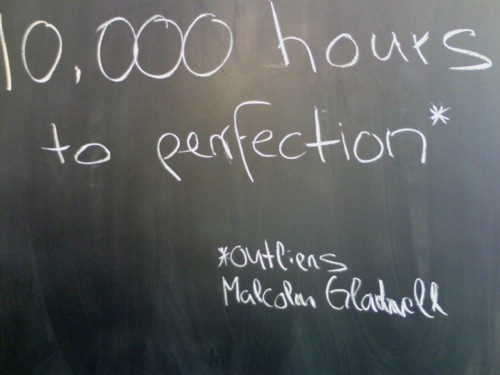
In his book Outliers Malcolm Gladwell is exploring this question. In an elaborately documented research he relativises the frequently quoted argument of Talent / Gift / Calling and demonstrates that it is nearly almost (always?!) a mixture of a well chosen moment, ambition, passion and, finally, work, i.e. effective hours on the mat :-). And this is what Bill Joy (one of the founders of Sun Microsystems), The Beatles and Bill Gates - to name just a few of who have been examined carefully in the Outliers book - have in common.
The right instant of time is probably difficult to control and the same goes for our interests which are (partly!) out of our conscious influence.
But what definitely lies in our hands is the amount of work which we put into what is near and dear to us.
Thus, it is as simple as that: if you are really interested in something, do it as intensively as you can! That alone brings the experience and in the end mastership! Nowadays it is not necessarily wisdom that gives a head start to the masters (even if some masters under the pretense of tradition hinder the transfer of knowledge in order to create and maintain artificially established power structures or just to get - nothing else than financial - privileges!), but it still is the 10.000 hours-effort which not everybody is prepared to sacrifice for something. 10.000 hours in which you practise, sweat and try to make go until you finally have internalised and adopted what you wanted to learn.
Conclusion here: if you want something different from what you experience today, do something different - and do it as intensively as possible and more often than once a week :-) - from what you have done so far! Don’t blame your lack of talent ;-), but recognise your chance and go for it!
Look at Michael Jordan’s Maybe it’s my fault and stop looking for reasons! Just get started!
Technorati Tags: Aikido


